Selecting a printing process for a particular product is not easy. The product’s surface, shape, design, materials used, and purpose may impact the outcome. The process which is effective for a flat product may not necessarily be applicable to a smaller product with curved surfaces.
For companies considering both screen and pad printing processes, it would be more beneficial to compare their practical differences rather than stick to a single printing technique. Such an approach will make the selection easier and will help to avoid extra complications in the production process.
What Should You Consider Before Choosing a Printing Method?
It all begins with the product. Before choosing any process, manufacturers should consider the placement of the graphic and what the final product will encounter during use.
Some of the things to keep in mind are:
- Is the surface flat, round or irregular?
- How much space do you have to work with?
- Is one color sufficient or more than one needed?
- Will the product be handled frequently?
- Will the graphic have to be legible for a prolonged period?
- How many products will be produced?
Answering these questions early can filter the available options and make the production process easier to plan.
How Does Surface Shape Change the Approach?
Product shape may actually make more difference during the printing process than many would think. A big flat panel provides enough space for the printer to do its job, whereas a smaller, rounded component may require more adaptability.
In the case of curved and recessed surfaces, the following factors should be taken into account:
- Recessed area depth.
- Angle of the surface.
- Size of the graphic.
- Location of edges.
- Component positioning.
All these factors might influence how the print looks. In some cases, a test run might be beneficial, especially when dealing with an unusual surface or when working in a small area.
Where Does Screen Printing Work Well?
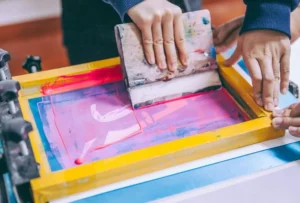
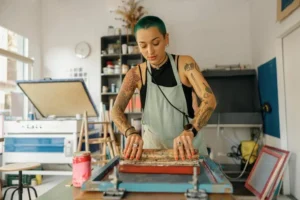
Screen Printing is one solution to consider when a product requires a visible graphic that is well covered. It is widely used for large graphics, large text, and logos.
Screen Printing may be an option for:
- Control panels
- Housings for equipment
- Signage
- Promotional items
- Graphics for industry
- Labels on products
- Plastic or metallic sheets
The design itself is another consideration. Larger, simpler graphics are easier to replicate than smaller, more detailed graphics.
Why Does Graphic Design Matter?
A printing process cannot solve issues related to making the design more readable.
Good artwork should consider:
- Size of the readable text.
- Spacing.
- Clarity of shapes and signs.
- Contrast.
- Proportionality.
- Right placement.
Simplicity will also help maintain consistency, which is particularly crucial if the same graphic is supposed to be used for a number of products.
When Can Pad Printing Be More Practical?
There may be products where the available printing area is reduced, and some uneven surfaces are present. In such instances, a more flexible printing method is preferred.
In Pad Printing, a silicone pad is used to transfer an image onto the product’s surface. Since the pad can bend while transferring, it is suitable for specific curved or indented surfaces.
Some of its applications include:
- Small parts.
- Round control buttons.
- Component housings.
- Indented sections.
- Technical components.
- Consumer electronic components.
This depends on the type and nature of the component itself. The best way to check is to test the component itself.
How Do Materials Affect Print Quality
Various surfaces may respond differently to the ink used for printing. For instance, an easy-to-print surface will not have the same printing arrangement as a coated or textured surface.
Manufacturers should consider:
- Type of plastic
- Metal surface
- Coating
- Texture
- Flexibility
- Moisture or chemical exposure
- Handling expectations
Surface preparation is very important. It can make a big difference. A properly prepared surface will enable proper bonding of the ink.
What About Different Production Sizes?
The volume of products printed may influence planning the printing project. For small print runs, flexibility and customization will be prioritized, whereas large-volume printing will demand consistency and an efficient manufacturing process.
For large quantities, manufacturers will probably pay attention to:
- Positioning of parts
- Ink quantity
- Settings of equipment
- Alignment of artwork
- Drying/curing
- Quality control
Maintaining all the above-mentioned factors consistently allows minimizing variations between individual units. Also, it simplifies repeating the process when a new print run is needed.
Can Printing Be Used for Functional Information?
Printing is not confined to logos or graphic designs only. Many objects have details that need to be printed to help consumers understand how to use them.
Such information could be:
- Instructions
- Warnings
- Scales
- Serial numbers
- Controller labels
- Directions
In these cases, clarity is particularly important, as it should be placed where users can easily read it.
How Can California Businesses Approach Printing Projects?
Local manufacturing needs can be diverse. A small company will have a limited number of custom parts, but large companies will require thousands of identical components.
Screen printing in California can use different materials, product types, graphics, and production volumes. Setting these parameters at an early stage can allow a business to find a suitable process for its particular needs.
It would be a good idea to provide:
- Final artwork
- Material specifications
- Part dimensions
- Production numbers
- Preferred colors
- Marking location
- Product durability
Project information helps the printing team understand the project before manufacturing begins.
What Can Help Avoid Common Printing Problems?
Most printing problems can be easily avoided with some basic preparation. Running ahead without examining the artwork, surface, or position is likely to cause wastage that could have been avoided.
Some actions that the manufacturer can do include:
- Testing the design on a sample
- Examining the printing position
- Checking compatibility with materials
- Checking the artwork
- Confirming color needs
- Inspection of early products
This might take some time, but it might make things easier later.
Making the Final Choice
The appropriate form of printing would ultimately depend on the product and what must be achieved through the completed marking. The shape of the surface, the nature of the material, the design, the volume of production, and the durability would all have to be considered.
Pad Print USA could assist companies in evaluating their requirements and identifying appropriate printing methods. Early discussion of the product could make the selection process for an effective printing method easier.